19 Forces and moving-boundary work
The accepted smoke demonstration supplies one localized acceleration in a fixed box. The separate explicit body-force API now distinguishes acceleration and force density in the fixed-box carrier. The native wall/force progression adds finite wall traction, compatible no-slip and uniform forcing in a separate fixed slab. This chapter’s prescribed moving-solid and two-way coupling requirements remain research specifications. The first decision is whether motion is prescribed or dynamically coupled. A scripted paddle can supply arbitrarily large work without losing momentum. A dynamic paddle requires a body mass, inertia, reaction force and compatible time integration.
Units before parameters
Use metres, seconds and kilograms internally. Density is kg/m³, dynamic viscosity is Pa s, and kinematic viscosity is m²/s. An acceleration changes velocity by ; a force density , in N/m³, changes it by . A source of liquid volume is neither of these. Its addition must appear in the volume ledger and pressure compatibility condition.
For a face mass , an acceleration-only update satisfies
The second term explains why logging old-velocity power alone does
not reproduce a finite explicit step’s energy change.
force_work_identity checks this exact scalar identity. The
reference fixture verifies it for a signed acceleration; it makes no
general stability claim.
One geometry interval
A rigid prescribed boundary has world velocity . Retain pose, translation, rotation and version for the interval consumed by transport, pressure, viscosity and output. Sampling only the final mesh pose can miss a swept collision. Sampling wall velocity from one pose and cut volumes from another breaks displaced-volume accounting even if pressure residual is tiny.
For an outward fluid normal, sealed moving-wall flux is positive when fluid-domain volume grows. Reynolds transport gives , with . Incompressibility on a moving control volume uses this geometric volume change, rather than imposing a zero sum of all wall fluxes blindly. A translating obstacle inside a fixed sealed container preserves total fluid-domain volume; a piston moving inward does not unless a compensating outlet or source exists.
For fixed-volume cell constraints choose an outward-positive internal
incidence B (the negative of Chapter 16’s head-positive pressure
incidence) and write , where
internal incidence columns sum to zero and is an integrated volume source. Summing
yields the necessary component condition . sealed_flux_compatibility proves this
implication under explicit balance and solved-constraint hypotheses. It
does not prove a solution exists. Moving-cell schemes must additionally
supply their geometric conservation law.
Pressure and external work
Prescribed boundary data make divergence affine. The weighted adjoint relation includes pressure work , as Chapter 8 derives. Separate known boundary terms before testing a homogeneous transpose identity. For two-way coupling use the same normals, areas and pressure interpolation for wall flux, force and torque. Otherwise an apparently correct pressure solution can exchange inconsistent momentum. The variational solid-fluid paper provides the primary coupled formulation [E1].
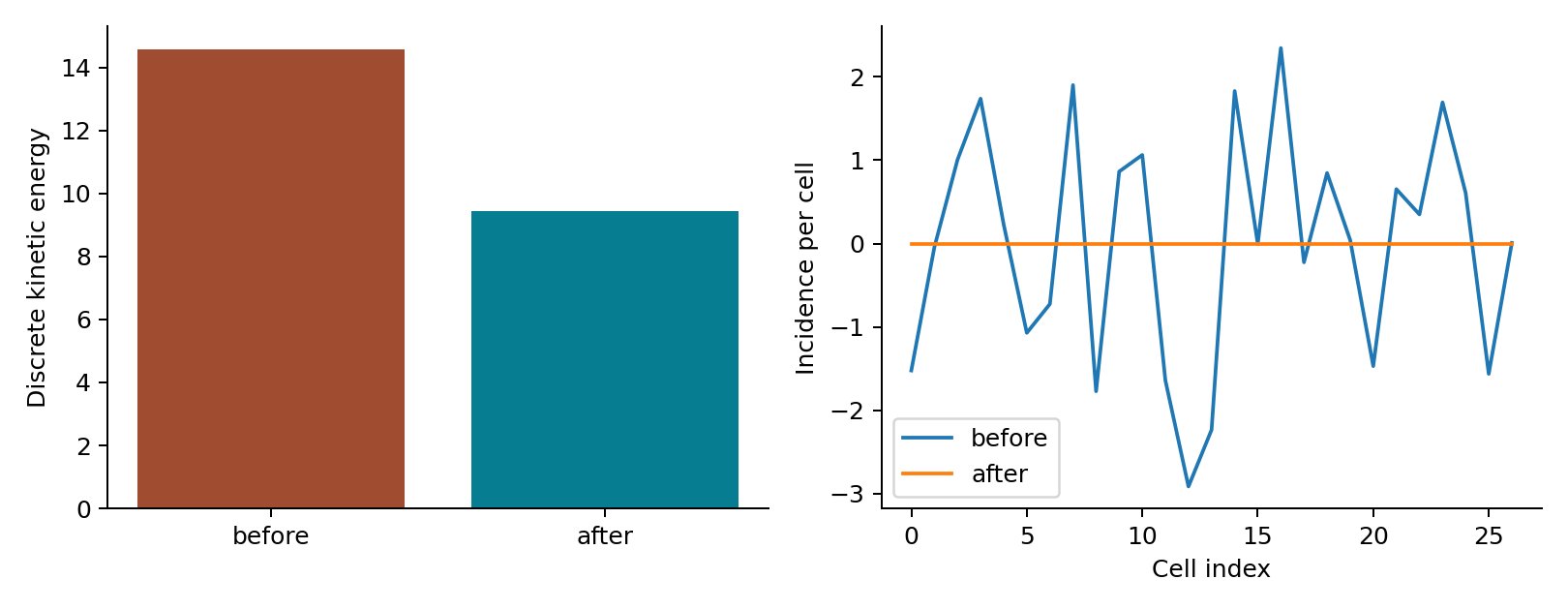
The original three-cell amount ledger stores balanced and incompatible prescribed flux vectors. Their sums illustrate the necessary component condition; the separate 27-cell projection reference executes a dense pressure solve. No moving-wall pressure solve is claimed. The 3D mesh lab shows prescribed translation and the velocity at a selected collision; it is not a moving-solid fluid solve.
Implementation contract and experiments
Proposed ForceField distinguishes acceleration from
force density; BoundaryInterval owns immutable start/end
geometry and motion. Reject nonfinite input, stale geometry,
unclassified boundary and incompatible component source before
publication. An accepted report retains force work, wall work, source
volume, physical time and geometry version. Failure leaves the
previously accepted state coherent.
Begin with gravity and a flat tank. Then use a translating closed obstacle, a rotating paddle and a piston with a specified outlet. Compare volume change against integrated boundary flux, include both signs of wall motion, and refine temporal sampling. Dynamic light-body added-mass tests belong to a later two-way implementation; prescribed-body examples do not establish them. Mesh query accuracy and liquid volume transport remain separate obligations even when the exact algebra passes.
Work in a frozen-geometry operator
Let M be a positive mass matrix, K a nonnegative strain operator, C a tangential sample map, and Λ a nonnegative wall-friction matrix. With wall samples w, generalized force f and equation residual e, suppose
For r=Cv-w and kinetic energy E, the finite work budget is
The minus sign in actuator work follows from wall force −Λr on the fluid. Laboratory-frame energy can increase while relative friction dissipates. The residual must be taken from this unscaled equation, with its norm and normalization declared. This richer matrix statement is a next proof target, numerically checked in small synthetic systems; it is not one of Physics.lean’s thirteen compiled contracts. Prescribed normal-wall pressure work requires its own affine constraint term.
An affine projection M(v-u)+Aᵀλ=0, Av=b gives E(v)-E(u)+½‖v-u‖²M=−λᵀb. Here λ is impulse-scaled. A homogeneous stationary constraint has zero right side; a moving constraint supplies work. Feasibility is separate from pressure gauge uniqueness. For two-way solids, combine fluid and body masses and use one adjoint constraint J. Common translation conserves the corresponding generalized momentum only if J annihilates that mode; angular momentum additionally needs rotation modes and consistent interaction points. These are frozen-geometry specifications, not completed moving-solid proofs.
Signed work at a moving wall
Use the steady wall-load example with μ = U = 1 and G = −2. Tractions on the fluid are bottom 0 Pa and top 2 Pa; mean velocity is 1/3 m/s. The moving wall supplies 2 W while the opposing body force removes 2/3 W, leaving dissipation 4/3 W. Work is signed: body forcing need not inject energy. This one-metre, unit-area solution is a teachable traction and power oracle, not a moving mesh or two-way coupled body. At general boundaries use total Cauchy traction, including pressure, and distinguish the normal pointing out of the fluid from the normal pointing out of a solid. Prescribed outlet traction also needs a compatible inflow/backflow policy and pressure reference; importing a benchmark with a different boundary operator changes the problem.
Practical study proof scope
PracticalStudy.lean states the exact real-arithmetic premises. The pinned kernel build and 330-declaration audit passed; the integrated proof files match that checked source. The independent finite oracle checks the browser formulas; it does not prove a Rust refinement, IEEE solver, continuum prediction or runtime speed.