22 Viscosity, stress and dissipation
Density and viscosity have different roles. Density weights inertia; dynamic viscosity relates deformation rate to stress; kinematic viscosity controls a simple diffusion time scale. Treating a viscosity slider as an arbitrary velocity damping factor hides both the material units and boundary work. The first liquid research model is Newtonian, with positive density and nonnegative viscosity.
Symmetric strain
For , Newtonian stress is . Its power dissipation is . The cross derivatives matter: rigid rotation has zero symmetric strain even though velocity gradients are nonzero. A scalar component Laplacian is equivalent to the incompressible constant-viscosity interior equation only under the matching assumptions and boundary terms.
Batty and Bridson’s original viscous-free-surface paper separates normal and tangential traction and builds a compatible variational discretization [E4]. Their later variable-coefficient Stokes formulation supports irregular moving boundaries [S11]. Basilisk’s original viscosity implementation is another useful code reference for coupled stress components [E5]. These sources motivate a choice; they do not qualify Rheon’s future stencil.
Finite dissipative update
Let face masses form positive diagonal , let E map face velocity to strain samples, and let nonnegative quadrature coefficients form W. Put . Homogeneous stationary boundaries and zero external force give backward Euler
Taking the inner product with v and completing a square yields
implicit_energy_identity checks the finite identity from
an explicit scalar work equation.
implicit_energy_nonincrease adds nonnegative time and
dissipation to obtain the inequality. Its finite sums use arbitrary
positive masses, so variable density is represented without assuming
uniform kinetic weights. It proves neither that an iterative solve
reaches the work equation nor that E is the actual symmetric-gradient
stencil.
Moving walls and body forces add work on the right. Energy need not decrease then. A diagnostic should compare measured energy change against viscous dissipation and declared external work, with residual and rounding budgets, rather than reject every energy increase.
Checked bridge from strain to the implicit equations
Checked bridge from strain to the implicit equations
The earlier Physics contracts require a scalar work identity. The new BoundedPhysics contracts derive that identity for a defined fixed finite-strain operator. For arbitrary finite dimensions n and m, let E map velocity degrees of freedom to strain samples, and let μ_e be fixed material/quadrature weights. Define
Thus K=Eᵀdiag(μ)E. viscous_work derives .
dissipation_nonnegative derives when every weight is
nonnegative. The exact coordinate backward-Euler hypothesis is
backward_euler_work derives
directly from these equations.
backward_euler_energy_nonincrease then applies the existing
finite energy theorem: with m_i≥0, Δt≥0 and μ_e≥0, . The
coordinate update and positive-weight hypotheses replace an assumed
dissipative-work conclusion.
The theorem permits zero masses and weights, so it does not prove invertibility, existence or uniqueness. E is arbitrary and fixed during the step; no theorem here identifies it with an assembled symmetric-gradient stencil or proves a rigid-rotation null mode. This is an unforced homogeneous step. Moving-wall work, free-surface traction, nonlinear coefficients, approximate solves and IEEE rounding remain outside its statement.
For the exact witness E=[−1,1], μ=2, unit masses, Δt=1/4 and u=(1,−1), the computed update is v=(1/2,−1/2). The weighted squared norm falls from 2 to 1/2; kinetic energy with its 1/2 factor falls from 1 to 1/4. The derived work is 1/2=Δt·2. A negative weight μ=−1/2 instead gives squared norm 32/9, while an arbitrary candidate not satisfying the update can also increase it. These are exact rational witnesses, not liquid simulations or material calibration.
Shared shear-mode oracle
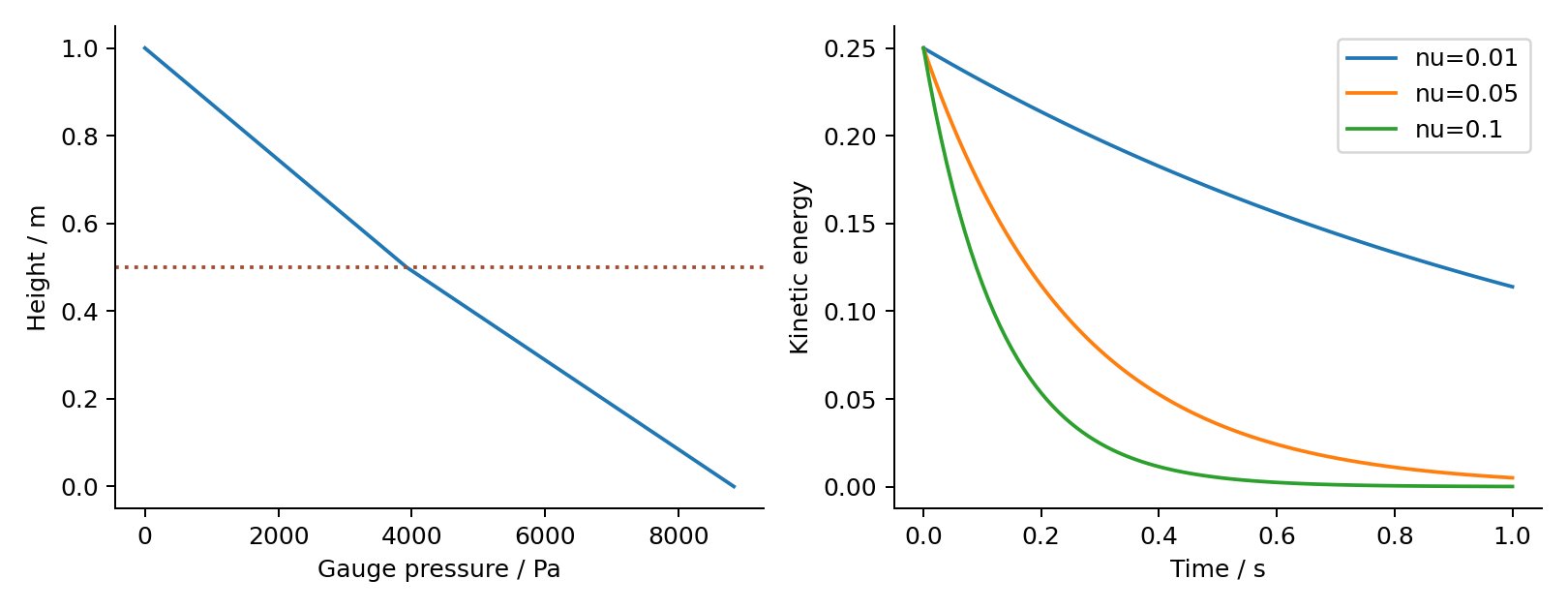
The reference code constructs a 32-cell periodic difference matrix with spacing 1/32 m. A sine mode has discrete eigenvalue . With s and chosen from 0.01, 0.05 or 0.1 m²/s, backward Euler damps amplitude by .
An independently assembled dense solve verifies the modal formula at each step. The browser displays the resulting velocity arrows in a three-dimensional slab and reports mass-weighted kinetic energy. The same profiles and energy records generate the book figure. A large implicit step remains damped but does not reproduce exact exponential decay; the error is shown rather than treated as a performance improvement.
Boundary and material tests
The filled-box Newtonian implementation uses symmetric strain under stationary free-slip box boundaries. The separate native wall/force progression qualifies fixed layer-uniform Navier/no-slip walls and external force, with an explicit simultaneous step. Its explicit squared-increment work correction differs in sign and interpretation from the backward-Euler decay identity above. Neither implementation supplies arbitrary embedded/free-surface stress coupling.
Use affine shear to check the stress law and rigid rotation to check the strain nullspace. Add periodic decay, no-slip channel flow, prescribed-wall Couette flow and free-surface traction. The first two are local operator tests; a complete free surface additionally needs pressure and stress coupling. Explicitly record whether a split assumes zero normal viscous stress.
Generalized Newtonian and viscoelastic materials remain later research. A shear-dependent viscosity needs an admissible range and nonlinear residual; viscoelasticity needs history and its own stress evolution. The existing finite-budget nonlinear specification in Chapter 10 remains valid. This expansion does not quietly turn it into an implemented material law.
A stable operator can damp the wrong mode
Positive semidefiniteness only says that a quadratic energy decreases. It does not imply that the stencil preserves rigid rotation. For Ω about the z axis, points at (−1,0,0) and (1,0,0) have velocities (0,−Ω,0) and (0,Ω,0). Pairwise vector-difference smoothing sees a difference of magnitude 2|Ω| and penalizes it, although the continuum symmetric strain of the rigid field vanishes. A future assembly theorem must show Br=0 for sampled rigid translation and rotation under explicit geometry assumptions. Only then does K=BᵀWB annihilate those modes.
Isolate viscosity for that fixture: a fully rotating drop still needs centripetal pressure, advection and capillary shape dynamics. Check an affine shear field separately, so a stencil that simply applies zero force everywhere cannot pass. At a free surface, normal and tangential traction belong to the stress condition; independent scalar diffusion with convenient component boundary conditions can violate it even when the interior formula matches μΔu.
For comparison with particle methods, the original Weiler et al. viscosity work evaluates conservation, spatial/temporal refinement and spurious viscous forces R12. Those criteria transfer as questions to ask of a grid method; its published performance and accuracy do not transfer as Rheon results. PBF positional density constraints, artificial pressure and postprocessed smoothing offer a different real-time model R15. Label their coefficients by their actual equations instead of silently assigning μ or σ units.
Draft checkpoint: stationary-box Stokes acceptance
Unmerged PR45, reviewed at
bbc6089888e257962b968e70ed84ec61b7668d5b, implements an
opt-in aligned
Stokes experiment. It combines bounded explicit symmetric-strain
decay with a pressure proposal on a fixed aligned-box domain. The
obstacle is stationary and no-slip; outer walls are sealed and
free-slip. It is not the production liquid timestep or a moving-body
solver, and this book branch does not import that implementation.
The independent rational controls construct a cell cycle around all four sides of the central obstacle in a 3³ grid with 26 wet cells. With unit density and viscosity, initial energy 1 J and dt = 1/32 s, the ideal discrete step ends at 731/1024 J with exactly zero cell flux. Pressure is zero by symmetry in this case. Predict the energy loss (293/1024 J), then compare with the separate asymmetric curl: it develops nonzero intermediate flux and needs a nonzero pressure correction. The ring alone does not demonstrate the ability to solve a nontrivial pressure field.
The qualification driver enumerates 13 one-step cases (eight accepted specimens and five refusal specimens) plus two three-step sequences. These are a finite acceptance roster, not 15 successful runs or a convergence study. During book coordination, ten exact mathematical controls were independently rerun in normal and optimized Python; native execution and the draft owner’s source-bound native receipts remain separate evidence. Exact oracle flux is not a claim that every accepted binary64 field has identically zero divergence.
The experimental Lean statements assume sound enclosures of energy changes, flux and momentum defects. They derive conditional acceptance implications; they do not establish Rust/IEEE enclosure soundness, compiler correspondence or continuum convergence. They are outside this branch’s root Lean inventory and theorem counts. The native interval path has explicit Linux x86_64/default floating-environment premises and can refuse unsupported or unresolved arithmetic. An unenclosed scalar stability estimate cannot authorize an actual step.
The experiment has no advection, source forcing, inflow/outflow, free surface, variable material, capillarity or moving geometry. It exposes no production clock/generation owner and is not integrated into PR48’s transport facade. Calibrated wall loads, arbitrary meshes and two-way body/contact dynamics still need their own geometry, work, impulse and rollback contracts. A stationary viscous acceptance case does not complete those broader physics topics.
Affine rotation and shear
Use a centred unit cube as a measurement region, not a no-slip container. Prescribe U=(-s y,s x,0), constant viscosity mu, and pressure zero. This is rigid rotation: the velocity gradient is nonzero but D=(grad U+grad U^T)/2 vanishes. Consequently tau=2 mu D, traction and constitutive dissipation vanish. Teal arrows show actual sampled velocity at a fixed scale; the field is planar and independent of z. Camera motion does not advance the field.
Boundary work supplies shear
Select U=(s y,0,0). Its two off-diagonal strain entries are s/2. The unit-cube dissipation is mu s² W, which is 1 W at unit rate and viscosity. Orange arrows show tau n at the six face centres, using a separate labelled traction scale. The integral of traction dot velocity over those faces is also 1 W.
Constant stress has zero divergence here. Dissipation is supplied by boundary work, not an evolving bulk-force calculation. All affine component Laplacians are zero. Comparing mu grad U:grad U with 2 mu D:D while omitting the different boundary terms would be misleading. These imposed fields do not satisfy stationary no-slip conditions on the cube faces.
Extension control
For U=(s x,-s y,0), dissipation and supplied boundary power are 4 mu s² W. Changing the sign of s reverses the velocity and traction but leaves power unchanged. Setting viscosity to zero removes traction and dissipation while leaving the prescribed velocity intact. Read the complete matrices and six-face quadrature in the research dossier. Batty and Bridson’s section 3, equations (3.1)–(3.5) provides the constitutive/traction context; this lesson does not implement their embedded-boundary solver or inherit its convergence results.
Planar stress proof scope
EngineeringFlux.lean proves the planar power formula, nonnegativity when mu>=0, and rotation/shear/extension values. The boundary theorem checks the stated finite contraction. Geometric quadrature, PDE evolution and code/IEEE refinement remain separate claims.
From viscosity to a specified turbulence closure
A turbulence-model name alone is not a reproducible constitutive law. The constitutive research record pins the SST-2003 limiter and pressure convention, distinguishes its primary 1992 motivation from later formulas, and identifies the transport and wall requirements still absent from a supplied-field constitutive probe. No SST transport or validation result is supplied by this chapter.
A specified SST-2003 limiter
The supplied-field probe uses density 1, a₁ = 0.31 and the SST-2003 denominator max(a₁ω, SF₂). Select k = ω = 1, S = 4 and F₂ = 1: eddy viscosity is 0.0775 Pa s, raw production is 1.24 W/m³, and the production cap gives 0.9 W/m³. The raw and limited production bars share one fixed scale, so their heights show clipping directly. The viscosity bar uses its own unit scale; compare the numerical values when comparing production and viscosity. They do not depict velocity or resolved eddies. The variant and primary-reading record pins coefficients, stress/pressure convention, source correction and wall data.
The zero-k constitutive limit
Set k = 0 with positive omega. Eddy viscosity and both production readouts are zero, and the denominator stays positive. This verifies the constitutive limit; the browser does not evaluate an undefined zero-viscosity omega source. A full transport implementation must define that limit, solve k/omega diffusion and cross-diffusion, compute wall distance/blending, enforce boundary and positivity policies, and report nonlinear residuals. The limiter inequalities prove nonnegative bounded algebraic production under stated premises; they cannot validate separation, turbulence spectra or a drag prediction.
Practical study proof scope
PracticalStudy.lean states the exact real-arithmetic premises. The pinned kernel build and 330-declaration audit passed; the integrated proof files match that checked source. The independent finite oracle checks the browser formulas; it does not prove a Rust refinement, IEEE solver, continuum prediction or runtime speed.